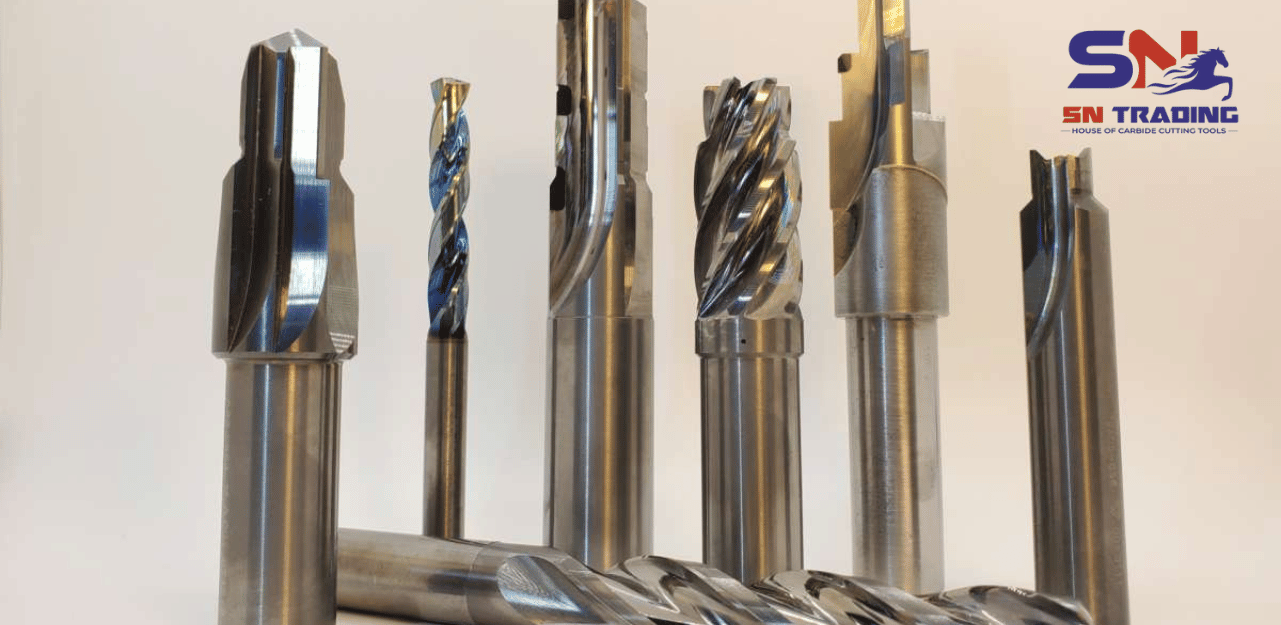

What are Carbide Cutting Tools
?
Cutting tools are small shanks with cutting edges, often known as cutters. These
cutters are designed specifically to extract stock from materials during an
industrial cutting or machining process, in contrast to the typical cutting
tools we are used with in daily life that dissect materials, such as knives. The
cutting tool must be sufficiently rigid to perform the machining activities
because the workpieces the cutting tools cut are often hard and rigid.
The cutting tools utilized in today's machining and engineering industries come
in a variety of sizes, shapes, and materials. One of the most often used tools
in today's world are carbide cutting tools. Carbide cutting tools, which
reinforce the tool and improve cutting performance, are constructed from a
carbide material, coated with a carbide coating, or have a carbide cutting edge
at the tip of the cutter rather than being made entirely of the material.
The modern industrial and engineering industries frequently use carbide cutting
tools for a variety of reasons. The cutting tools' improved physical qualities
from the carbide coating or cutting tip enable them to do the job they are given
with greater efficiency. Carbide enables cutting tools to operate at higher
temperatures while yet maintaining their cutting ability. Due to its physical
characteristics, carbide offers greater benefits for tooling.
Carbonized Metallic Material :
Cutting tools are frequently made from the mineral carbide. In essence, it is a chemical compound made of carbon and other elements (metallic elements in this case). Titanium, tantalum, and tungsten are the common metallic materials mixed with carbon to manufacture industrial cutting tools. Because of their physical strength, rigidity, and resistance to wear, pressure, and heat, carbonized metallic materials are prized. Solid carbide tools are another name for carbide cutting tools.
Tungsten Carbide :
The first carbide material that generally springs to mind when thinking of carbide cutting tools istungsten carbide
. In actuality, tungsten carbide cutters are what people mean when they mention the word "carbide cutting tool." Early 1900s can be used to pinpoint the introduction of tungsten carbide cutters. Since that time, tungsten carbide has been used to make cutting tools and inserts because it offers faster cutting speeds, a greater feed rate, and a longer tool life.Carbon and tungsten are both present in equal amounts in tungsten carbide. Such a material has great stiffness thanks to the construction; it is twice as stiff and dense as steel. In addition to its exceptional rigidity, tungsten carbide also scores a 9 on the Mohs scale for hardness. Because of this, tungsten carbide is perfect for creating abrasives, machining tools, and cutting tools. Other solid carbide kinds besides tungsten are also used to make cutting tools.
Titanium Carbide :
Titanium carbide is yet another typical carbide material used to create machining tools. The Mohs scale places titanium carbide at 9 along with tungsten carbide. High cutting speeds, precise results, and a smooth surface are all characteristics of titanium carbide-made machining tools. Machining tools made of titanium carbide are typically utilized on materials made of steel. To improve wear and corrosion resistance, it is occasionally added to tungsten carbide. An instrument with a longer life and superior machining capabilities is produced by combining titanium carbide and tungsten carbide.Tantalum Carbide :
Tantalum carbide is less rigid and hard than tungsten and titanium carbides. It is more frequently used as a tool's coating layer. It can also be added to tungsten carbide as an additive to improve the material's resistance to corrosion. Tantalum carbide's superconductivity is one of its main characteristics. Tantalum carbide can be used as the electrode material thanks to superconductivity. In EDM wire cutting procedures, a tantalum carbide electrode is used as the cutting tool. Instead of using a traditional cutting tool, materials are sliced by sparks during a wire cutting procedure. For cutting intricate shapes on workpieces, it is suitable.Advantages Of Carbide Cutting Tools
The physical characteristics of solid carbide cutting tools, despite the materials used in their manufacturing, make them frequently used in metalworking processes. In comparison to other kinds of cutting instruments, they can produce better outcomes. Carbide cutting tools are also quite inexpensive to use. Of the different tooling solutions available on the market, they are one of the least expensive ones. Cutting tools made of carbide are preferred for these two reasons.